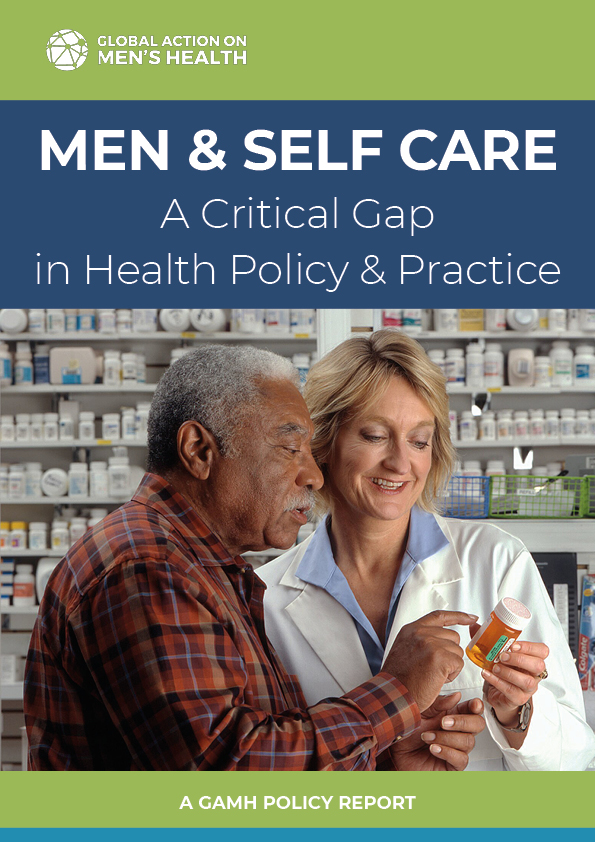
Men & Self-Care: A Critical Gap In Health Policy & Practice
May, 2026
GAMH is highlighting the importance of self-care when it comes to boosting men’s health.
Our new report, Men and Self-Care: A critical gap in health policy and practice, presents a comprehensive, evidence-informed framework for policymakers at global and national levels to improve men’s self-care. The report, endorsed by the Global Self-Care Federation (GSCF), argues that improving men’s self-care is essential to achieving stronger, more equitable and more sustainable health systems. It presents a comprehensive, evidence-informed framework for policymakers at global and national levels, combining structural reform, behavioural insight and service redesign.
Men’s self-care is a critical yet underdeveloped dimension of global and national health policy. Men’s ill-health not only impacts on men themselves, but costs societies billions of USD annually with negative impacts on others, particularly women. Men experience poorer health outcomes, lower life expectancy and higher rates of preventable disease and mortality than women, with men’s life expectancy at birth 71.5 years globally, five years behind women. These disparities are closely linked to men’s weaker engagement in self-care practices, including lower use of preventive services, delayed help-seeking, poorer symptom recognition and suboptimal management of chronic conditions.
The report builds on a previous GAMH report, Who Self-Cares Wins: A global perspective on men and self-care, including new evidence and recent developments in the men’s health policy field. It identifies six priority policy areas to increase men’s engagement in self-care and improve men’s health outcomes:
- embedding men in health policy frameworks
- strengthening regulation of health risks
- improving access to male-responsive services
- enhancing health literacy
- investing in workforce training
- and accelerating research.
The report was launched at a roundtable held alongside the World Health Assembly in Geneva, Switzerland in May 2026.
GAMH CEO Peter Baker says:
“Advancing men’s self-care is not simply a matter of individual responsibility but primarily a systemic public health priority with significant implications for economic productivity, health system sustainability and social wellbeing. Poor male health is not inevitable and can be tackled effectively through targeted health promotion, more accessible primary care services and policies that take specific account of men. This new report provides a roadmap for policymakers, including the WHO and national governments, to guide better policy provision for men’s self-care.”
Greg Perry, Director General of GSCF, says:
“Self-care approaches offer an important opportunity to improve men’s health through improved health literacy and better and more cost-effective use of health services which also reduces the burden on health systems. Men’s health presents a problem characterised by scale, severity and complexity. It is, for all these reasons, a significant public health issue that requires a strategic and systematic public health response. Given the extreme pressures currently facing health systems across the world, a fresh look at the issue of self-care is particularly timely.”